Our four fields of action:
Facility Management - Site Branding Services
Die klare und eindeutige Kommunikation der Unternehmensstruktur setzt sich in der Umsetzung eines Leitsystems der Büro-, Meeting- sowie sonstigen Nebenräume fort. Präzision und Klarheit helfen Zeit zu sparen und Mitarbeitern schnell den Zugriff auf Kapazitäten zu gewähren.
Aufbauend auf bestehenden Konzepten der Corporate Identity und des Corporate Design setzt ein professionelles Gebäudeleitsystem eindeutige Standards.
Mitarbeiter-Qualifikation und Coaching unterstützten ebenso die Unternehmensidentität in einer gelebten Praxis wie optimale Vorbereitung von Meetings und Veranstaltungen.
CAEvolution unterstützt Sie gern bei der langfristigen Begleitung Ihrer Facility-Communication und optimiert Schnittstellen zwischen Gebäuden, Standorten, internen Veranstaltungen sowie der gezielten Qualifikation Ihrer Mitarbeitern.
PLCA - (P)LCA (Predictive) Life
Cycle Assessment
Life Cycle Assessment offers a high potential to strengthen a product’s
and/ or business’ performance encouraging the engineer and end user to
assess environmental, economic and social impact of product development from
a holistic perspective, and ideally, in a predictive way upfront to the
broadest extent possible. Knowing that material data, simulation models and
processes are based on assumptions, simplifications or knowledge all input
must be understood as context dependent and might change under future
scenarios and assessments. Therefore, Life Cycle Management runs through
different phases and individual processes which are influenced and steered
by different technical instruments such as software or simulation systems.
The earlier instruments of simulation are used, the cheaper and more
optimized products can be designed and produced. The following concept of
training employs interdisciplinary approaches and offers you a combination
of theoretical lecture and hands-on-workshop to integrate your questions
and ideas into your training.
Read more about PLCA in our proposal:
Strategy
In our opinion, a sustainable strategy implies creating new courses of
action, identifying new opportunities and gaining additional power in a
smart and effective way. Or saying it in the words of Michel Foucault: „I' m
no prophet. My job is making windows where there were once walls.“
Read more about Strategy in our coaching proposal:
Reaching out for new and resilient options and gaining deep insight on
all aspects in the value chain are key objectives of the economy in 21st
century. Balancing our human capital, managing advanced technology and
innovation, social responsibility, consciousness in the use of natural
resources, raw materials and energy consumption are not only buzzwords but
keys to success. The time of the ‚classic economy' which was mainly targeted
on creating a maximum of economic expansion by increasing production, is
over. New ideas and fresh impulses like an upcycling or retrofitting of
products and processes must be planned on a strategic scope laying the base
to success.
Diversity offers potentials for small and large scale
companies. Combining Change Management and Diversity, enables a completly
new perspective on a globalised ecomoy.
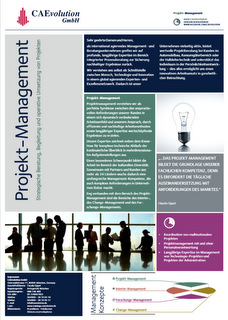
Projektmanagement verstehen wir als perfekte Symbiose zwischen den
anspruchsvollen Anforderungen unserer Kunden in einem sich dynamisch
verändernden Arbeitsumfeld und unserem Anspruch, durch effiziente und
nachhaltige Arbeitsmethoden sowie langjähriger Expertise wertschöpfende
Ergebnisse zu erzielen. Unsere Experten zeichnet neben dem Know-How für
komplexe technische Abläufe der kontinuierliche Überblick in
mehrdimensionalen Aufgabenstellungen aus. Einen besonderen Schwerpunkt
bildet die Arbeit im Bereich der kulturellen Diversität. Gemeinsam mit
Partnern und Kunden aus mehr als 24 Ländern wuchs dadurch eine
umfangreiche Management-Kompetenz, die auch komplexe Anforderungen in
Unternehmen lösbar macht. Eng verbunden mit dem Bereich des Projekt-Management sind die Bereiche des Interim-, des Change-Management und des Forschungs-Managements.
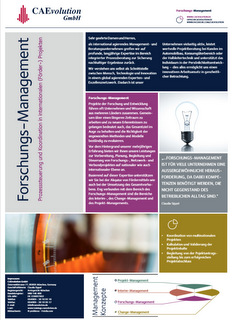
Projekte der Forschung und Entwicklung führen oft Unternehmen und
Wissenschaft aus mehreren Ländern zusammen. Gemeinsam über einen längeren
Zeitraum zu arbeiten und zu neuen Erkenntnissen zu gelangen bedeutet auch,
das Gesamtziel im Auge zu behalten und die Richtigkeit der angewandten
Methoden und Modelle beständig zu evaluieren.Vor dem Hintergrund
unserer mehrjährigen Erfahrung bieten wir Ihnen unsere Leistungen zur
Vorbereitung, Planung, Begleitung und Steuerung von Forschungs-, Netzwerk-
und Verbundprojekten auf nationaler wie auch internationaler Ebene an.Basierend auf dieser Expertise unterstützen wir Sie bei der Akquise von
Fördermitteln wie auch bei der Umsetzung des Gesamtvorhabens. Eng
verbunden mit dem Bereich des Forschungs-Management sind die Bereiche des
Interim-, des Change-Management und des Projekt-Managements.
Die strukturierte und operative Umsetzung von Inhalten im Namen und
Auftrag unseres Kunden, innerhalb seiner Unternehmensstruktur, auf Zeit und
in direkter Abstimmung mit seinen Zielen, verbunden mit dem hohen Anspruch
schneller Integration und professioneller Lösung komplexer
Herausforderungen, all dies vereint der Begriff des „Interim-Management“.
Die steigende Volatilität des Marktgeschehens erfordert dabei die zeitnahe
Reaktion auf aktuelle Herausforderungen.
Seit mehr als einer Dekade
stehen wir als zuverlässiger Partner unseren Kunden langfristig als
Mit-Unternehmer zur Seite und sichern damit die wirtschaftliche und
effiziente Umsetzung von Projektinhalten. Dazu zählen sowohl Inhalte der Technologie als auch die passgenaue
Unterstützung der Geschäfts- und Konzernleitungen auf operativer und
strategischer Ebene. Unsere internationale Ausrichtung erlaubt uns,
wertvolle Impulse für „neue Themen“ wie das Change-Management und
Diversity in Unternehmen zu lancieren und nachhaltig zu betreuen, z.B.
Expatriates. Sowohl in Deutschland als auch im europäischen Umfeld sind
wir für unsere Kunden aktiv.